

VIEW ALL BLOGS
February 10, 2026
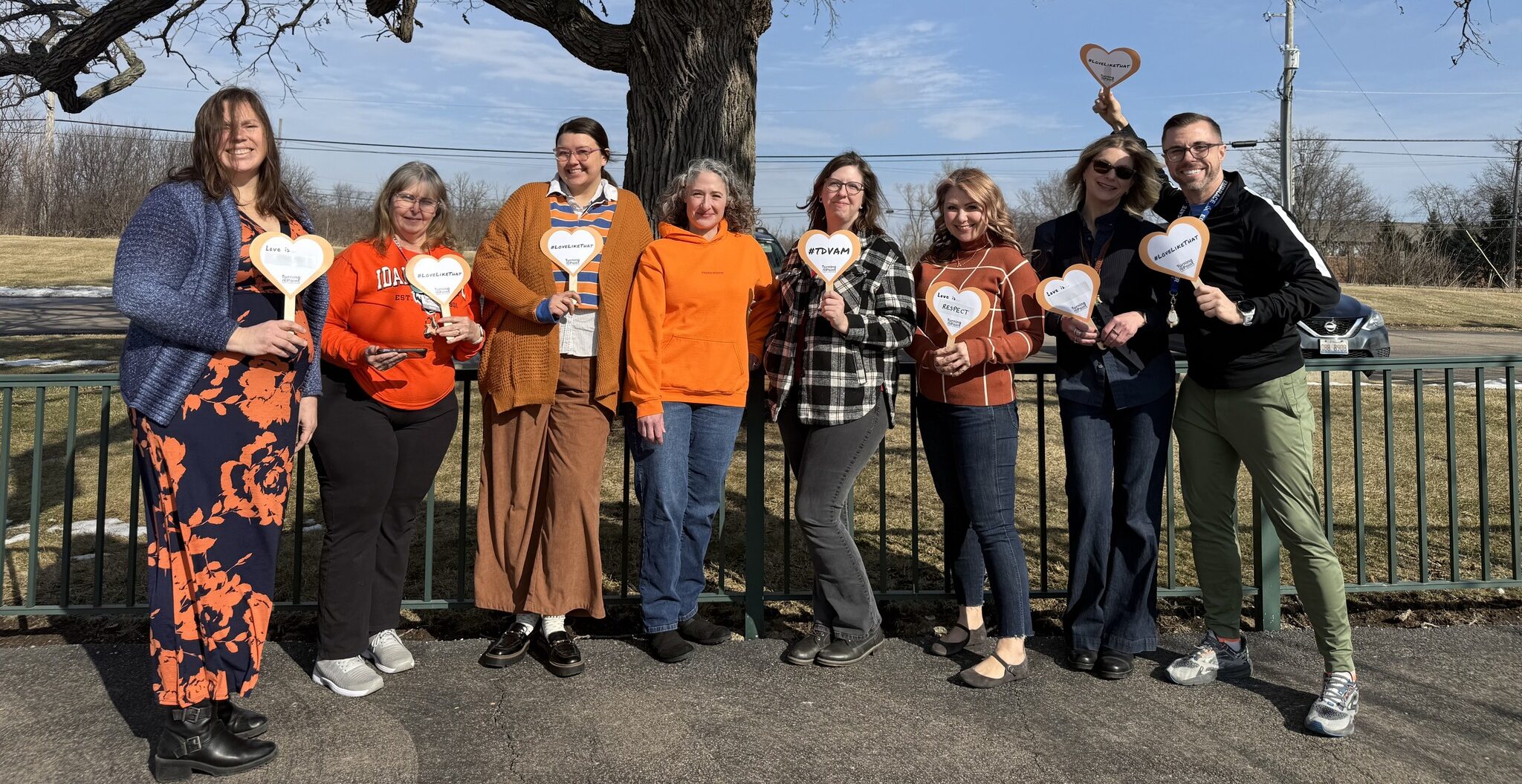
Turning Point Staff on Wear Orange Day for Teen Dating Violence Awareness | February 10th, 2026
February is Teen Dating Violence (TDV) Awareness Month, and with Valentine’s Day right around the corner we are working extra hard to help start as many conversations around these important themes as possible with parents, professionals, and teens alike to educate and raise awareness. Unfortunately, we know in our work here at Turning Point that teen dating violence continues to be a prevalent issue. In the past year alone, 1 in 10 high school students in the United States reported having experienced some form of dating abuse. For many, this abuse may be dismissed or ignored due to teens not knowing what abuse looks like, or because the adults around them fail to take their relationships seriously.
Only 1 out of 3 teens who were involved in an abusive relationship chose to confide in someone about the violence they were experiencing.
Here at Turning Point, we serve teen clients and know the effects teen dating violence can have on their well-being, sense of safety, and future relationships. In the outreach department, we continue to visit as many schools as possible to provide teens with the tools they need to recognize abuse and to keep themselves (and their relationships) safe and healthy.
Before beginning the conversation, it is helpful to have a basic understanding of what teen dating violence actually is. Like intimate partner violence or domestic violence, teen dating violence is the willful intimidation and abusive behavior as part of a pattern of power and control by one intimate partner against another in teenage dating relationships. Teen dating violence can take many different forms, including physical, verbal, mental, financial, sexual, stalking, and digital.
Teen lives are influenced by a number of different factors, including pop culture, societal norms, the relationships they observe in their families and friends, and the content they consume online. Some of the trends that we are seeing in the teen world when it comes to abusive relationships include isolation from friends and/or family, making false accusations about things such as cheating, explosive temper, possessiveness, telling their partner what to do, telling their partner who they can and cannot speak to, and forcing or pressuring someone to participate in sexual acts or send nude photos.
Teens may be unaware of certain strategies that they can implement to help foster healthy relationships, such as setting boundaries, processing conflict, and identifying multiple trusted adults in their life that they can go to if they need assistance or support. Learning to set and communicate boundaries, and how to process conflict in healthy ways, can be really challenging for teens—especially if these skills are not being explicitly taught and modeled. Boundaries can take many different forms, can be different from different people in our life, and can only be decided by you depending on what you are or are not comfortable with. Additionally, it is important to stress the importance of having trusted adults in many different areas of your life (i.e. school and at home) so that they have multiple options of adults they can go to for support, for help, and to confide in.
At Turning Point, we work to ensure that our clients, especially teens, are aware of their rights and what they can do if they are experiencing domestic violence in their relationships. Teens (12-17) have the right to receive up to eight 90-minute counseling sessions without parental consent. Sometimes, teens are not ready to have conversations with their parents about what they are going through but are aware that they need further support. Teen survivors also have the right to obtain an order of protection. However, since they are minors, they are required to have an adult 18 years or older to petition on their behalf. It is important to note that the petitioning adult does not have to be a parent or legal guardian.
For more information regarding teen dating violence, visit Love Is Respect (loveisrespect.org) or Teen Dating Violence Awareness and Prevention (teendvmonth.org). For additional survivor support, the National Teen Dating Abuse Helpline is a great resource for teens to receive immediate, confidential assistance from trained advocates either over the phone or text. Similarly, the MCHelp app is a free anonymous app where teens can confidentially text or talk to a licensed mental health counselor that is available 24/7. These counselors can also get teens connected with more resources around McHenry County. Turning Point advocates are available via our hotline 24/7 at 815-338-8081 to provide support to teens or get them connected to more resources.
Credits
Gwen Gallagher is an Outreach & Prevention Advocate at Turning Point Domestic Violence Services. She graduated with her bachelor’s degree in public health from Bradley University and is currently pursuing her master’s degree in public health with a focus in family and community health through Purdue University. She is licensed as a Community Health Education Specialist (CHES) and has worked with the youth population for many years. She truly believes that building up the next generation with important knowledge is essential for a healthy, thriving community.
Editor
Tiffany Hudson, Outreach & Prevention Coordinator
