

VIEW ALL BLOGS
November 12, 2025

When asked to write a piece on the history of Turning Point, my hope was to capture the mindset of the original group of women who formed the organization in the late 70’s. We can surmise what conversations took place which ultimately drove the decision to form a grassroots domestic violence (DV) agency. It was a brave undertaking to right a wrong in a culture which saw domestic violence as a family matter, not to be dragged into the courts or talked about in social settings.
I dug up little timeline from the agency’s 2005 Annual Report. This would have been Turning Point’s 25th anniversary and pivotal events were outlined. To paraphrase:
1981 – Turning Point is incorporated and a few volunteers set up a crisis hotline out of their homes.
1982 – Crisis hotline moved to a local church were a church employee answered calls. Space was provided by the Unitarian Church.
1983 – Turning Point moved to Westwood School. I think this was Westwood Elementary in Woodstock.
1985 – Volunteers provided space in their homes for survivors and their families.
1986 – Turning Point started to offer “Alternatives to Violence”.
1987 – The agency moved in to the “Old Church” on Tryon across from the Dairy Queen. I believe they are referring to what is St. Mary’s on Tryon & Washington.
1988 – First DV Advocate hired! Kay Shackelford officially joins Turning Point.
1989 – The children’s program formed by three volunteers.
1990 – The first children’s advocate hired – Judy Beyer. Some of us here today remember Judy fondly.
1991 – Rough year for TP. Here’s what the timeline says verbatim, “The office roof leaks, there is little heat and, one day, there is a racoon found sitting in the middle of the children’s playroom.” It took grit back in those days.
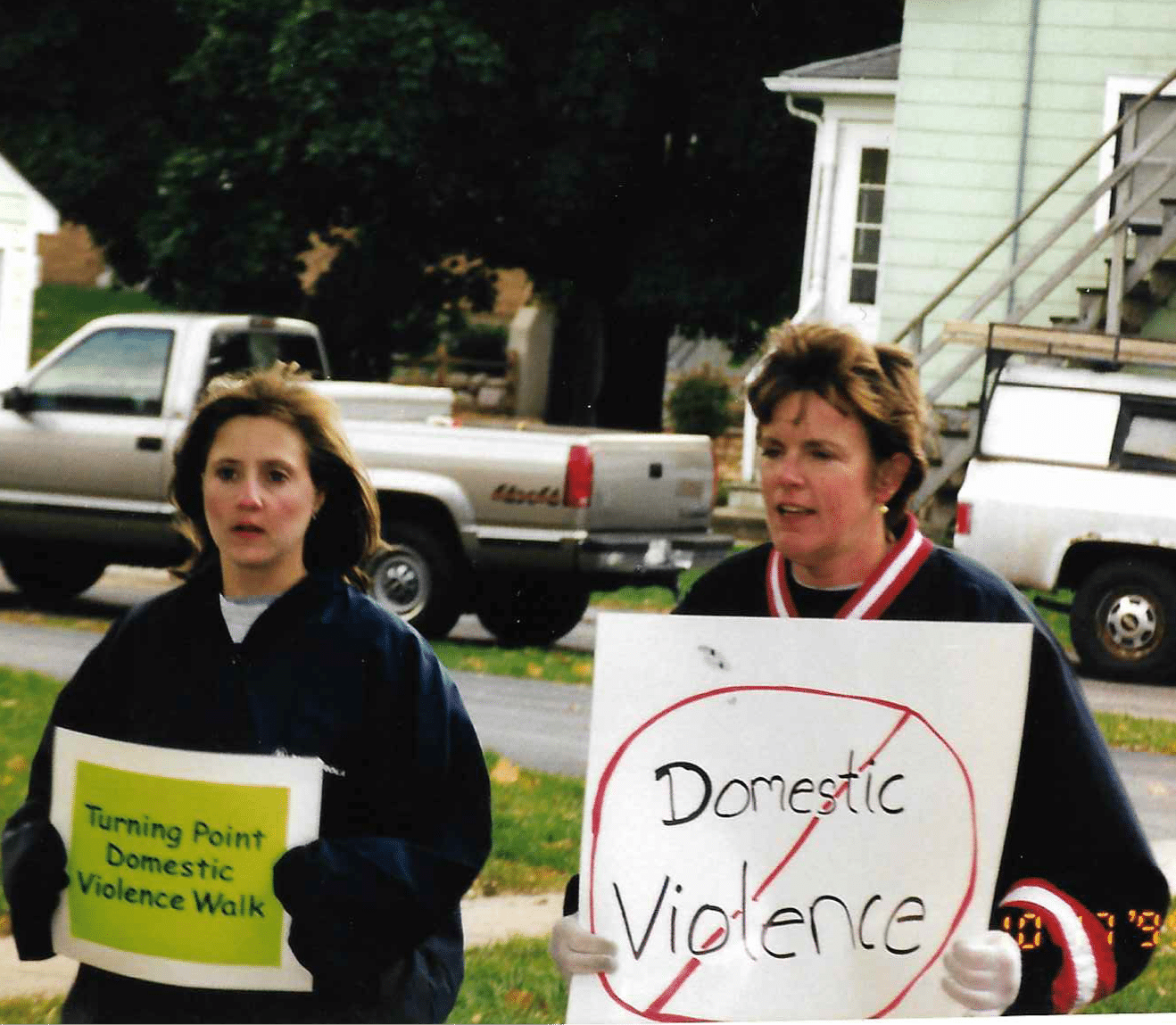
1992 – A group of staff and supporters walked from the old Centegra Behavioral Health building on in Woodstock to the McHenry County Courthouse in solidarity of DV survivors and to raise awareness in our community. It would have been a little over three miles and I’m sure the group made sure they were seen and heard.
1993 – A big change for Turning Point! They moved into an office on Route 47 and Calhoun in Woodstock. Advocates shared one large office. Racoons remained an issue!
Another insight from Mary was that “back then” the courts did not like Turning Point and what the agency stood for. Statements were made to the tune of, “there had better be blood on this OP before I sign it” were made. Attitudes bordered on hostility towards what TP represented. This persisted.
1994 – Turning Point hired Janie Galarza as its first bilingual/bicultural DV Advocate. Much like Judy, some will remember Janie and her huge contribution to the agency.
1995 – Another rough patch for TP. The agency acquired a property on Rte. 14. I am pretty sure they are referring to the “white house” which is an important part of agency lore. In front of the shelter you will see the remnants of a building foundation. This was the aptly-named “white house” which was a precursor to our admin building.
According to Mary D., the attic housed the advocates and the administration worked out of the garage. Advocates drove their personal vehicles to survivors’ homes to pick them up and bring them for services including OP’s.
1996 – TP again faced challenges related to office space. The lease on Calhoun expired while renovations were being done on the white building to bring it up to code. Advocates worked in two trailers in the parking lot and nominal office space was donated by local Cornerstone Clinic. Without the technology we have today, this must have been quite an undertaking. Of course, they persevered. This will prove to be a theme.
1997 – The family domestic violence council is started by Turning Point in addition to a parenting program.
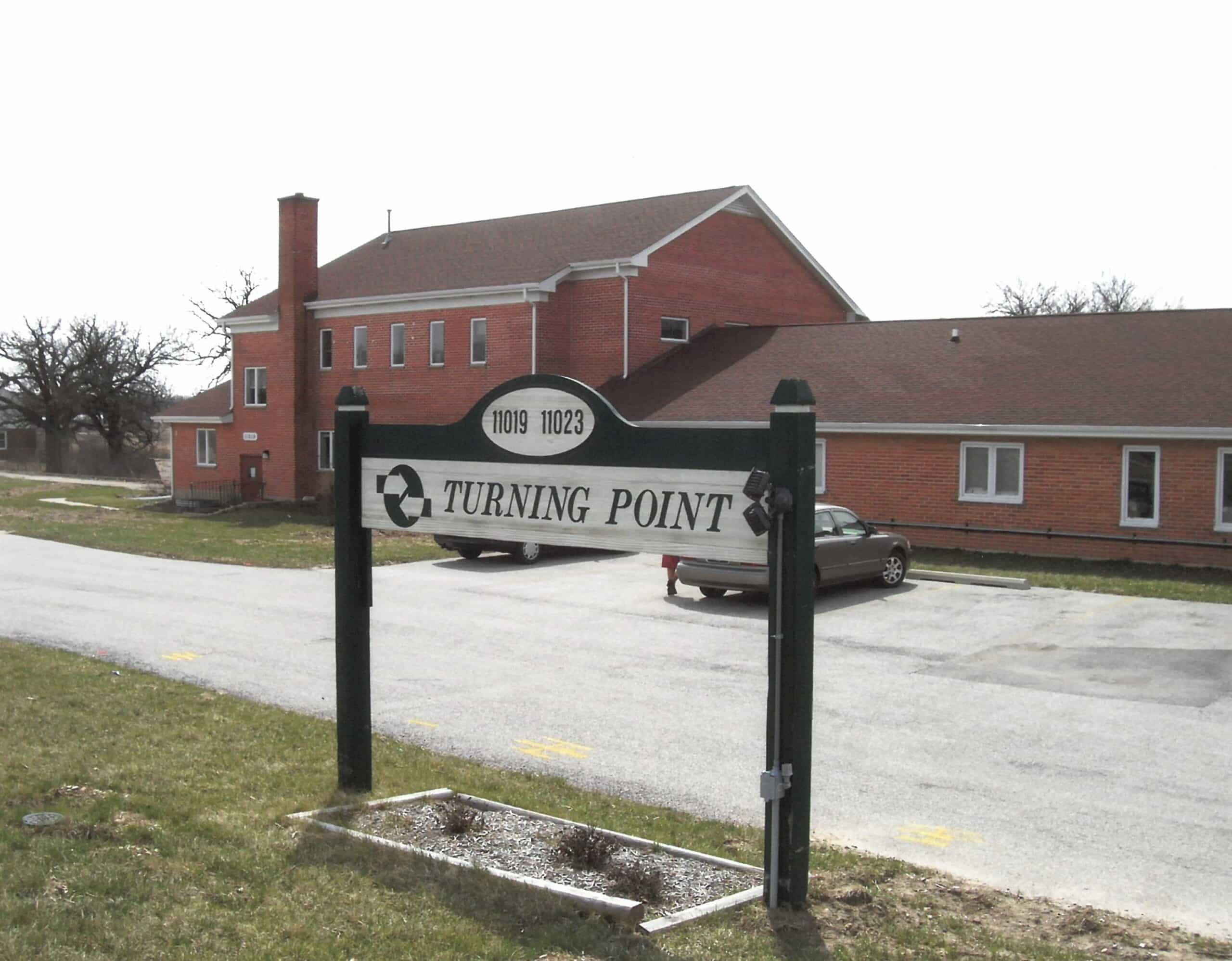
1999 –The admin building which we know and love became the home of Turning Point. TP inhabited the west side of the building only at first. Family Health Partnership Clinic was also in this building.
2002 – Groundwork is being laid for a future shelter. This was a huge, expensive project which would have its share of trials and triumphs before actually opening to serve DV survivors.
2004 – The shelter is completed but cannot open due to financial limitations. Again, so much went on in this era with the shelter that it would best be left for another time.
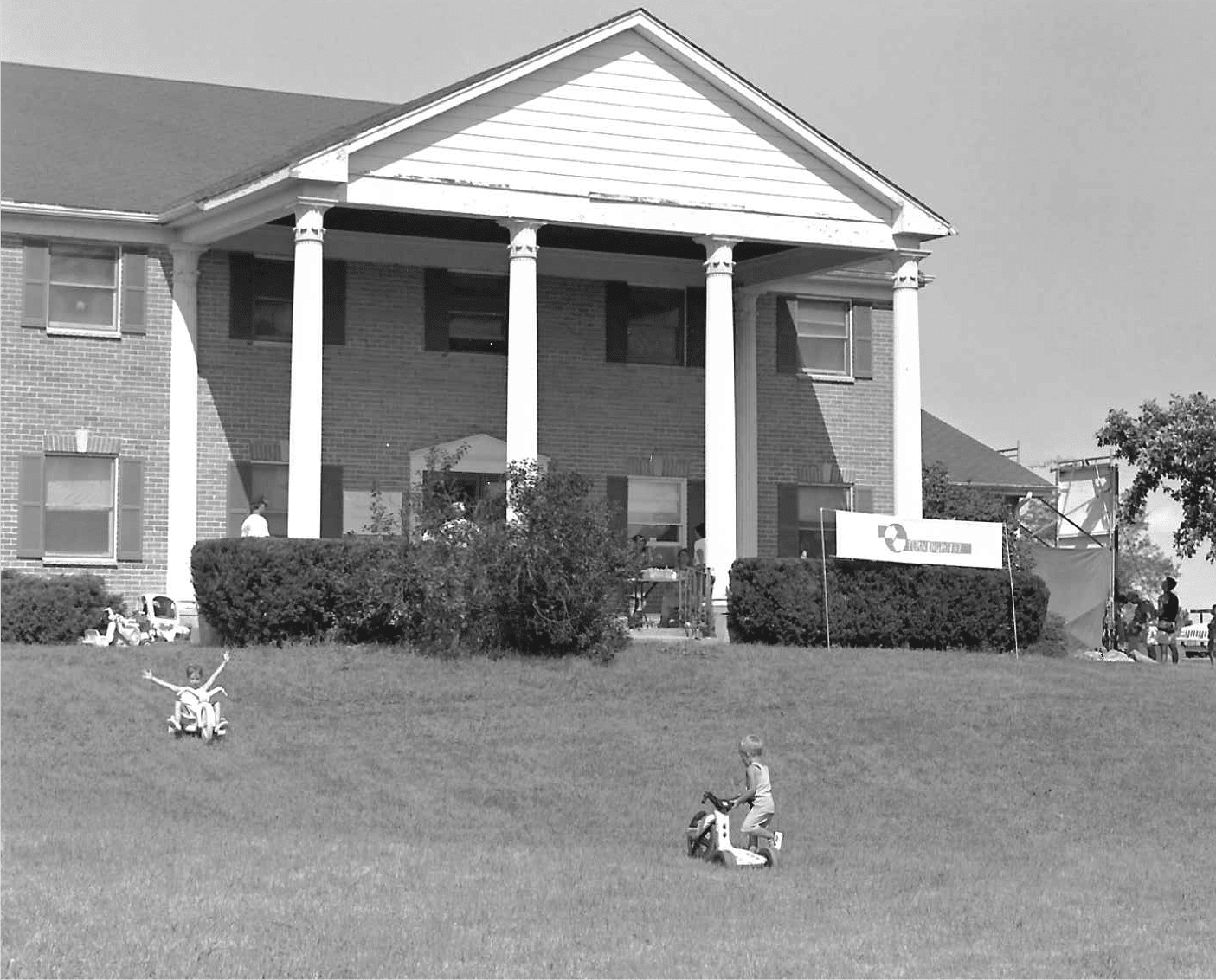
2007 – The shelter opened thanks in large part to two local private contributors (Superheroes!) and has evolved into the life-saving community resource that it is today. The playground was also built.
Turning Point is nearing its 45-year anniversary based on its incorporation in May of 1981. Programs and services have been developed and refined to meet the needs of the population we serve since the agency’s humble beginnings.
Sometime around 2016 the shelter began taking teenage boys as part of family units. Prior to this, families with teen boys were housed in a hotel. Then, fast forward to 2018 or so, and men were allowed in shelter. It was a groundbreaking decision to do this, and I remember that change vividly. We changed our mission statement from:
Confronting violence against women and children in McHenry County
to:
Confronting domestic violence in McHenry County
That same year, the board of directors also updated our vision statement to: actively ensure the rights of women, children and men to a home safe from violence, fear and intimidation. The addition of “and men” was important.
These changes were not about semantics, but rather an important shift in understanding. I believe it was in response to the changing perceptions of DV in our communities and letting go of outdated assumptions regarding the “battered” and “batterer”. We now say, “those who have chosen violence” and “survivor”. Those words reframe an issue which is complex and difficult to confront. However, just like the legacy of those who came before us, you best believe we are going to try.
Credits
Nancy Erickson is a Grants Associate with Turning Point who has been with the agency as an employee for nearly 10 years. Prior to this, she was a direct-service volunteer. Nancy holds a Bachelor of Science degree in Industrial/Organizational Psychology from the University of Illinois – Urbana.
Editor
Mallory Breutzmann, Event & Fundraising Coordinator
